
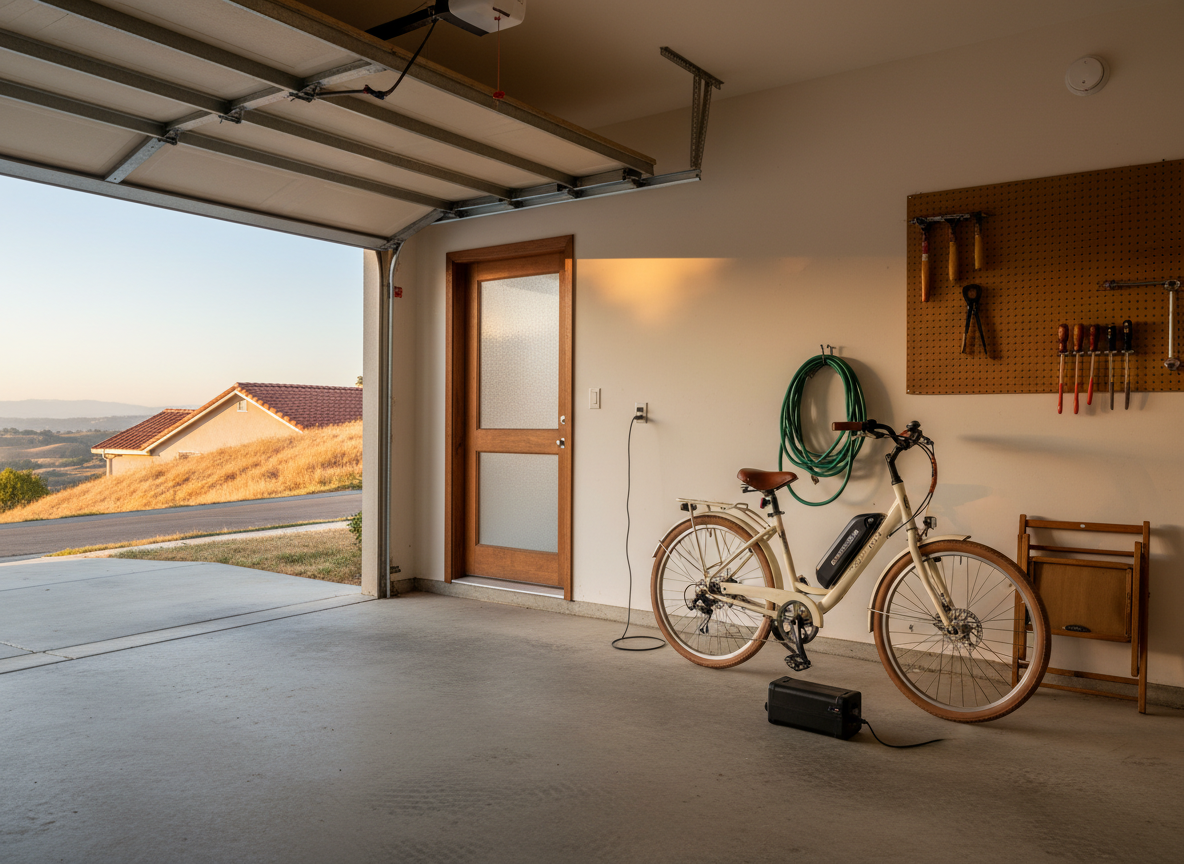
If your only smoke alarms are the single units in the hallway, an e-bike battery fire in an attached garage may not wake you in time. The fire starts behind a closed door, and a hallway alarm cannot sense it until smoke has already pushed into the house. Interconnected, monitored smoke and heat detection, with a heat detector in the garage itself, is what closes that gap.
Fire Prevention Week runs October 4 through 10 this year, and the National Fire Protection Association chose lithium-ion battery safety as the 2026 theme. That is a good reason to walk out to the garage tonight and look at what is plugged in. This post covers how to charge e-bikes, scooters and power tools, why a battery fire behaves differently from a kitchen fire, and what detection in the garage does that a hallway alarm cannot.
Why an e-bike battery fire moves faster than a kitchen fire
A kitchen fire usually announces itself. Smoke builds, and the alarm outside the kitchen picks it up while the fire is still small. A lithium-ion battery fire skips most of that warning. When one cell inside the pack fails, its heat sets off the cells next to it, a chain reaction firefighters call thermal runaway. The pack can go from warm to open flame in seconds, and it keeps feeding itself from the inside, which is why water slows these fires without always stopping them.
Most e-bike battery fires start while the battery is charging, and most home charging happens in the garage, at night, with the door to the house closed. That combination is the whole problem. The garage is full of things that burn, the family is asleep, and the smoke has a wall and a door between it and the nearest alarm. By the time a hallway alarm sounds, the fire has had a head start.
Where and how to charge an e-bike, scooter or power tool
The NFPA’s lithium-ion safety guidance is plain enough to tape to the garage wall. Charge on a hard, flat surface with nothing stacked on or around the battery. Use the charger that came with the device, not a substitute that happens to fit the plug. Unplug when the battery is full instead of leaving it on the charger overnight. Keep the bike or scooter out of the path to the door. If a battery is swollen, hot to the touch, hissing, changing color or giving off an odor, stop using it and get it out of the house.
The rule most people skip is the overnight one. Charging while you sleep feels efficient, and it is exactly the window when nobody is awake to smell smoke. If a battery has to charge overnight, that is the strongest argument for detection in the garage that talks to the rest of the house. And an old or damaged battery never goes in the trash can. Riverside County’s household hazardous waste program takes them.
What interconnected, monitored detection does that a hallway alarm cannot
A single-station smoke alarm has one job, which is to make noise where it hangs. It does not tell the other alarms, and it does not tell anyone outside the house. Interconnected detection changes that. On the ProSiX life safety line A-Bell installs, when any one smoke, heat or carbon monoxide device goes into alarm, every other life safety device in the house sounds too. A detector in the garage sets off the one in your bedroom.
Monitoring adds the second half. A monitored detector reports through the alarm panel to the central station, so help is on the way whether you are home or not, and you get a notification on your phone through the Total Connect app. We wrote about how monitored smoke detection works in the Temecula Valley last year, and the mechanism is the same here. A battery fire is a faster, quieter reason to want it.
In a garage specifically, a heat detector is the right device, not a smoke detector. Garages are dusty and hot, and a smoke detector hung there will nuisance-trip until you pull the battery out of it. The ProSiX heat detector alarms at 135 degrees, or when an already warm garage heats up faster than fifteen degrees a minute, which is what a battery fire does. It resets after an alarm instead of needing replacement. Our older post on fire safety tips for the garage still holds up on clutter and storage.
Fire Prevention Week in Temecula, Murrieta and the rest of the valley
E-bikes are everywhere here now. They are on the trails in Temecula and Murrieta, at the schools in Wildomar and Winchester, and parked in garages across French Valley, Lake Elsinore and Canyon Lake, usually plugged in a few feet from a car, a shop vac and a shelf of paint cans. October is also the month Santa Ana season begins, and the fuels in our hills have been drier than normal since August. This valley does not need an e-bike battery fire in a garage in October.
If you are out this month, the Canyon Lake Car Show is October 3, the Temecula Greek Festival runs October 16 through 18 at the Promenade, Peltzer Pumpkin Farm is open through the 31st, and the Temecula Halloween Carnival is October 30 at the Civic Center. Every one of those is an evening the house sits empty with something possibly charging in the garage. Enjoy the evening. Unplug the bike first.
What A-Bell does about it
A-Bell has protected this valley since 1985, and Chris personally handles every installation, so the person who walks your garage is the person who decides where the detector goes. We install First Alert ProSeries life safety devices: interconnected smoke, heat and combination smoke, heat and carbon monoxide detectors that sound at 85 decibels, talk to each other, and report through your panel to monitoring. The combination detector speaks its alerts in English or Spanish, so you hear the word “fire” rather than guessing at a beep pattern, and end-of-life alerts tell you before a detector quietly stops working.
The panel talks to the outside world over two paths, cellular and Wi-Fi, so the signal still goes out if the internet is down. Total Connect sends the alert to your phone at the same time. If your home already has hardwired smoke detectors from an older system, a converter lets those wired sensors keep working on the new panel. What we will not do is tell you the garage is safe from an e-bike battery fire because there is a smoke alarm in the hallway.
Should I put a smoke detector in my garage?
A heat detector is the better choice for a garage. Dust, exhaust and summer heat make smoke detectors nuisance-trip there, while a heat detector alarms on temperature and rapid temperature rise, which is how a battery fire behaves. Interconnect it so the bedroom detectors sound too.
Is it safe to charge an e-bike overnight?
The NFPA says no. Charge while you are awake and unplug when the battery is full. Most e-bike battery fires begin during charging, and overnight is the window when nobody is up to notice the first smoke.
How do I know an e-bike battery is failing?
Look for swelling, a case that is hot to the touch, hissing or popping, a change in color, or a chemical odor. Any one of those means stop using it and move it away from the house.
Will a monitored smoke detector call the fire department for an e-bike battery fire if I am not home?
A monitored detector reports through your alarm panel to the central station, which can dispatch help whether you are home or not. You also get a notification on your phone through Total Connect, so you know at the same time they do.
What should I do with an old e-bike battery?
Never put it in the trash or the recycling bin. Riverside County’s Department of Waste Resources accepts lithium-ion batteries at its household hazardous waste collection events, and many bike shops take back batteries they sold.
If you want Chris to walk your garage before Fire Prevention Week is over, call A-Bell Alarms at 951-302-3100 or reach us through our contact page. In business since 1971, in this valley since 1985, and we would rather help you unplug a bike than meet you after a fire.
About the Author: Kathy Sizemore

Recent Posts
If you enjoyed reading this, then please explore our other news articles below.